Monday, December 3, 2007

Murakami

Murakami's work seems to implicate the viewer in the art/commerce system. Whether it is a critique on the commercial aspects of the artworld or not is irrelevant- we become part of the circle, complete interactive art. The point of this article that stuck out to me was the name of his Louis Vuitton bag- "Neverfull". It speaks to the desire associated with art and retail. We are "never full"- always wanting more, better, faster...

Saturday, November 24, 2007

© Murakami or © LV

I start to notice one Japanese artist Yashitomo Nara by notebooks and T-shirts which are sold in one famous book store in Taiwan. Then I looked for the artist’s books and knew more about him and his works, a little girl with sharp expression in her eyes. It is a clever commercial tactic that the girl figure is not combined with any expensive brands. People can pay 30-50US dollars to have one T-shirts. The artist attracted more viewers by this kind of commercial trade and made his art more popular. Comparing to Takashi Murakami’s works, Yashitomo Nara’s little girl is pretty much “kawai,” at least to me. Facing to Murakami's“neverfull bag” which is decorated by the classic sign of LV, it only pushes me far away from his art, although I really appreciate the title of the bag. Maybe this collaboration actually wants to attract people who have more interest in LV instead of ART.

Saturday, November 17, 2007

Artist with Ph.D

Artists with M.F.A. can be interested in any fileds of theory and technique then go to pursue their Ph.D in school. The function of any program of school is offering an environment,like as intensive courses, a group of folks and a little financial support to keep your living. Schools are always the best instant way to acquir so-called "knowledge" and lable your identity.

Tuesday, November 13, 2007

Murakami

Part of me wants to be upset with Murakami's treatment of art as something so commercial, something of a large business enterprise. On the other hand, I feel as though we all want success on a large scale, at least LARGER scale. Murakami has found a way to critique society's standards (whether it involves an investigation of high and low, elite and popular, etc.) all while appealing to the very society which he is critiquing. I'm not sure I would enjoy being so completely immersed in the capitalist system like Murakami has been. But in all honesty, I wouldn't mind the income involved with his success. I guess it is a matter of what is more important to you as an artist, making a name for yourself or making work that you know you can live with. "Mid-career soul-searching" caught my eye when reading this article. It seems to imply that Murakami may not be satisfied/happy with all the work he has completed, as if he finds some form of conflict with it on a personal level.

PhD

PhD program based on theory-great idea, as long is it studio and research based. Thru the M.F.A program- you exploring your ideas, you are focused on yourself, what is good, but in the same time- two or three years, are not enough for some of us. Sometimes feels like you just scratched the surface. Then PhD is for you. For some of us it is all about: changes and exchanges informations- which you can get from even from traveling and collecting the experiences. I think I could believe that this can have the same equivalent as PhD program. I also realize that I still have to write a CV, and still somebody going to based on that.
Well, I hope that PhD “dedication” to aca-deme, not necessary means using the students to do research for somebody who is on PhD “path” (often in Poland), I want to believe that this ”dedication” rather means: actively working and finding an answer, or making statements in the field that is interested on. Actively in theory/and studio.

I am wondering if PhD program which is focused only on criticism/aesthetics- theory, would not be the same for students who graduated in art history? Some people might say that this is “their field”. Well, they are instructed “to make arguments not pronouncements”. Sometimes artists works the other way around, isn’t it? Maybe is like Barnet Newman says:” Aesthetics( so criticism) is for artist what ornithology for birds”?????????

Monday, November 12, 2007

Art PhD's

I actually have no problem with the studio PhD. While I do not think it should replace the MFA as a required degree for teaching on a college level, I see no reason why an artist should have to just end with an MFA. I know many people who have gone on after their MFA's to get PhD's in theory, philosophy, criticism and English. The thinking that everyone should get an MFA and be done with it, it limits the cross-discipline relationships that have become so important in contemporary art. As a student, I would not want a professor who stayed in the studio for six years straight and then came out to teach me. I want them to be well versed in technique, theory, writing, public speaking and have well-defined careers. I think on a broader scale- this is not just a question of whether or not artists should have to get PhD's, but also whether or not the MFA is seen as the beginning of a career or an artists "leveling out" point. The great thing about a PhD program is that it keeps the person active in a field for longer than just two years- I often question if this is enough time to really learn anything.
Being an artist is not like being an accountant. No one piece of paper is going to get you to the next level, that next pay raise. We really are on our own to personally make the decision to expand our knowledge base, gain further skills, get the shows and write the grants. So the question of the MFA versus PhD comes down to how much you want to grow. If that is what it takes to get the same respect as the sciences then i say fine, but it should be an option open to those who want it.

Wednesday, November 7, 2007

Art PHD

I think that the idea of a PHD in studio art is a administrative idea and used to help standardize and level out the degrees of the professor to better administrate to them. The MFA is a degree that allows the professor to work and continue with there artwork giving them valuable insight into the working of the art scene. In a PHD the artiest is doing more theory and criticism, and is driven away from the studio and the progression the there work receives in a focused study into there area.

Tuesday, November 6, 2007

How educated must ANYONE be?

This article really hits home for me as I battle with the decision to either continue with my MFA or to bring it to a screeching halt. I question whether or not all the education we receive in an institutional setting is all really necessary. There will always be an element of the real world and real situations that can just not be brought into the classroom. A doctorate for an artist seems like just another layer of education; something else to delay your life plans. I do not want to have to spend the majority of my life in school in order to be able to practice what I enjoy doing. While some of the skills that are provided in a doctoral program would seem to be beneficial to an artist they also seem like skills that can be acquired in a variety of ways. I am strongly against removing artists from the act of making/creating which is what a doctorate would seem to do. It is bad enough that institutions keep stretching out the length of their MFA programs, I can't imagine having to complete a doctoral program in addition to it.

This week's reading- Art PhD's

This week's reading, about the growing trend of PhD's in art, can be found at the following link: http://chronicle.com/temp/reprint.php?id=g48m608c8t6vfhnyx905zqztj8hgxy9d

Thursday, November 1, 2007

Mosque wearing

The most interesting aspect of Azra Aksamija's work, for me, is how many different fields of study she attempts to incorporate both in her work and in the way in which she works. Aksamija has to have a large understanding of architecture, Muslim culture, American culture, fashion design, knowledge of the textile industry, and of religion and politics in order to work on her wearable mosques. I do wonder if it is a goal of hers to directly reference the architecture of mosques or of any building in these works. I do not visualize any sense of a structure or of a building when I view one of her pieces. I would be very interested in seeing the reaction to her survival mosque from different areas of the world. Depending on the culture that work could evoke some very strong emotions-both positive and negative.

material use

I would have to say, after thinking about it a bit longer, that my biggest problem with Stelarc's third ear is that I don't understand why he had it implanted on his arm. I really need to know more about his purpose in order to be more accepting of it. As far as medical need vs. no need compared to the use of other materials by an artist that could also be needed for another purpose, I would have to say that it is not much different. I have actually been thinking alot about how wasteful we are as artists, especially since I've come to IUP. It is something that really concerns me.

Stelarc and all his ears

Hi all,
After reading your responses to Stelarc's third ear project, a couple of questions:

Some of you mentioned that the medical resources used for the project could have been better used to help someone who actually needed surgery for health reasons. So, do you feel the same way about an artist who spends a large sum of money on lumber and builds a sculpture with it? After all - that lumber and labor could have been used for housing someone who needs a home. Or is that somehow different?

Also, now that living tissue can be grown outside the body in a laboratory, how do you feel about using this material for art? What are the ethical issues here?

Tuesday, October 30, 2007

Third ear for art

I agree with Dave's statement that this third ear project is a waste of medical time and costs that could be going to someone who actually needed it. I also did not understand the artists exact purpose for doin this. The article mentioned he wanted to have a micrphone implanted to allow others to listen to what his extra ear picks up. How is that any different from what a normal ear would pick up? If his point is about listening then why not be concerating on listening to sounds invloving a regular ear, more people would probably relate to or understand it. A woman who was born without an ear claimed the work shows a lack of understanding. I can see why she feels this way. She has been living with one ear her whole life and clearly knows the physical and emotoinal stresses it brings. Then someone who was lucky enough to have both ears grafts a third onto his arm. It seems to be making light of her personal situation. Perhaps if the artist had some medical connection himself to this idea i would feel differently about it. While the science of it is fascinating to me, i just see this particular use of it as a waste.

Sunday, October 28, 2007

Do you hear me?

The extra era reminds me to think of my past students. Some of them have nice and complete appearances of ears but they are deaf or have problems in hearing. The way they tried to understand me is focusing on my mouth and body language to "see" what I talked about in class. Stlarc made a very vivid ear, a sculpture with perfect quality, which is composed by some very high technique but the small ear has no function. Comparing to 2D ear drawn on one forearm, this 1/4 scale 3D ear seems more strong and attractive. I don't understand why Stelarc hopes to have a microphone implanted to allow others to listen to what his extra ear picks up. It is unnecessary to duplicate one ear just for hearing what it picks by a microphone. He just need to set a microphone on his forearm. But I think there is one thing good that is the artist sets the third ear on his body instead of other animals.

Thursday, October 25, 2007

The third ear

I really believe this sort of thing to be absolutely ridiculous. A doctor's time and the amount of money spent on a project like this could go towards so many more important and helpful medical procedures for people that really need them. Perhaps I feel this way because of my overwhelming disgust for plastic surgery addicts and plastic surgery in general. In my opinion this type of procedure should not take place unless it is medically necessary/if it improves the overall quality of your life. While some of the research involved with Stelarc's project may be quite interesting and even valuable I do not deem the ear implanted under the skin of his arm as a necessary component. Sometimes money allows us to take things too far. You don't need an ear on your arm in order to capture/record what others say. My verdict: no clinical need= no surgery.

Wednesday, October 24, 2007

The Extra Ear

I think that the extra ear is more of a social experiment then an art project. It is a very interesting idea that makes you think about body modification, and it is comparable to people that have metal beads implanted under the skin to make designs show up on there skin. The ear that was made is a piece of art that was grown and attached to his arm. But what he is planning on doing with the ear is a sociological experiment into the body and the way you hear and interact with your environment. It is hard for me to fully embrace the ear on his arm as art and not as a strange body modification. It is also a little cruel to people that are deformed with extra toes and excreta with the adding and additional body part.

Monday, October 22, 2007

Carolyn Lambert

I found Carolyn Lambert's presentation a few weeks ago to be interesting. What i noticed most about her lecture was the medium she has been working in . Well, perhaps medium is the wrong word, but that my point here. I am not very familiar with performance art or documentation. It intrigues me that we can catatgorize this as part of "studio art" courses. I would veiw this as something fit more for the perfomance or thater arts department. I don't think it's bad or wrong that Carolyn's work is being classified in to the studio arts academically. It just makes me think about how we feel the need to catagorize everything. I think that this diversity of art is one of the things i love most about being an artist. We have many outlets and directions our work can take. Someone in sudio art courses has the opportunity to incorporate everything from dance, video and music in to their work, what other areas of study have that much openness and opportunity?

Sunday, October 21, 2007

Art star(world)& Top 100

These articles remind me to think about the billboard of art stars in my mind. I found that the art stars in my list are actually long-lived, like Marcel Duchamp and Louise Bourgeois. In their long life-spans, one of them kept on working in art world; the other turned to pursue other careers. Duchamp finally left from the art world to become an chess player since 1920s until the rest of his life. Bourgeois became famous in 70s, then people started to notice the "female artist". They focused on working with their interests, regardless whatever it is. What they want to do is simply to have fun with their careers.There are always lots of elements affect whether you can become a noted artist or not, usually not only depending on your talent in art. Maybe you need to find a good mentor, look for a good dealer and smell what will be the next most popular issue.... But I think if you want to be an artist the most important to keep your art career longer is to keep your passion and have fun with your works. It is really easy to feel frustrated when there is no viewer appreciating your work. By the way, another important thing is to keep healthy and live as long as possible or you will have no chance to celebrate your accomplishment.

Friday, October 19, 2007

Art Stars/ Top 100

There are millions of artists in the world. Many of which make their careers by making little cash and calling themselves artists. Some make their careers by becoming professors at an institution. Plenty of them make some money in galleries.
Why not? It’s life do what you want, in life you can do anything that the mind can imagine. Why limit yourself to being labeled as an artist. An artist in the modern day is becoming ever closer to being nothing than a corporation. Become a business man or a farmer if that’s what you want to do. Have tons of money and influence. Essentially that’s what this top one hundred artist thing is saying the top one hundred artists good at. Not necessarily their art. Like Aasta said its all dependent on what galleries you are in and how much money your work makes.
But time and time again through history we have seen artist come out of the woodwork and not even be alive any more. That’s part of the beauty of the art world. It has the power to immortalize a person. Even when the person is dead. Dealing with the modern capitalist industry and gaining fame in this life time is one way of dealing with becoming a successful artist. But it doesn’t mean that you have to do it to become famous. Or even make the best art. The top one hundred artists probably aren't even known. They are probably so far ahead in their thinking that people would not even understand a thing they create. These kinds of artists are untouched and pure. Their creativity is out of the world and unknown. These kinds of artists achieve an understanding of the world beyond what the New York and London galleries can even begin to imagine. Beyond what the Artstars can set precedent for. The actual top one hundred artists might be content with creating within their own minds exclusively. Not ever making a single work in the real world.
The life of an artist in the modern society is fleeting. up and down as Dave said. What’s the point? You can make money doing anything you want. Or make it selling art. But what’s the point in becoming one of the top one hundred artists. Just to gain power. That’s just what every other person in the world wants. Artists should be different, progressive and out of this world. Not concerned so much with achieving a world class status as a prominent gallery showman for some capitalist PIG!!!
-Aaron Treher

Thursday, October 18, 2007

Pittsburgh Gallery Crawl

Hi all,
The next Gallery crawl is on Friday the 19th from 5:30 to 9 in downtown Pittsburgh. It's a good time to see art - up to 20 galleries and other venues open at the same time, with free admission and often snacks, music etc.

You can see a list of venues here: http://www.pgharts.org/education/gallerycrawl.aspx

Next Critique Thursday, Nov. 1

Hi all,
The next critique in Sculpture will be Thursday, November 1. This has been moved back one class period from the original calendar from the beginning of class.

Guest Artist Adam Welch

Hi folks,
On Thursday, October 25, IUP sculpture graduate Adam Welch will be a guest artist in class. Since graduation, Adam has been exhibiting his work in the Pittsburgh region and was recently selected as the Pittsburgh Center for the Arts Emerging Artist of the Year for 2008. Adam will be doing a lecture as well as studio visits, so look for a sign-up sheet on my door.

Adam also has work in a show opening this Saturday night Oct 20 at Fe Gallery from 7 to 9 at 4102 Butler St., Pittsburgh (Lawrenceville), PA 15201.

Art Stars/ Top 100

The dual articles about Art Stars and also the newly posted top 100 really drive home the cause and effect in play here. If you notice on the top 100 list, there are actually very few artists- mainly it is collectors, curators and museum board members. The power lies not with the individual talent of an artist, but instead with who decides the said artist has talent in the first place. And to suppose that talent is the foremost decider is probably wrong too. It's about what is new or fresh- ie: what will make the gallery or dealer the most money. If you look at where most big name artists got their start it is usually behind a big name collector or gallery. A majority of the YBA (Young British Artists) got MFA's from Goldsmiths sold their first big piece to Charles Saatchi and had their first solo show at the Tate- it's not coincidence.
The Guerrilla Girls put out a great guide "The Art Museum Activity Book", which outlines the nepotism and hand-holding in the art world. In it they outline how most shows are actually from the private collections of board members and by giving the work press they increase it's value so they can send it to auction and make a tidy profit. Again, looking at the Top 100 list. Richard Serra went from #73 last year to #19 this year- which just happens to coincide with his huge Retrospective that was at MoMA this year. It also just so happens that over half the works were lent by private collectors. My guess is their investment just increased substantially with that jump. As long as we all just realize that it has nothing to do with talent and everything to do with economics we can all relax. There are thousands of artists in this world that 99% of the people haven't heard about but still have successful and fruitful careers. Personally, i would rather have consistency than a momentary flash.

art(star) world

Big name or "star" artists have always come and gone, sometimes reemerging. These artists are "popular" and it seems as though anything popular in our fast paced society is subject to a potentially short life span. I am not surprised at the varying levels of involvement in the art world by the artists originally depicted as stars in Robbins' piece.
When I think about career longevity I don't think so much about my position in the art world as a whole. I think more about what job I might hold and what I would need to do in order to make sure I can retain it for a number of years. At some point in my life I wish to become a professor, even if it is not at anything more than a small private college. I would consider my career successful if I was able to live comfortably off of a modest teaching salary while continuing to create work that I love.
The longevity of an artist that lives in the public eye is highly dependent upon that artist's popularity with the public and perhaps more importantly the art critics. It is my opinion that the artist has very little control over their own success(popularity).

Tuesday, October 16, 2007

Food is Art

Attention undergrads,

As you are working on your Bodily Reality projects, I thought I would share a link I just found, called Food Is Art. This is someone who makes "food art" for corporate events, parties, etc. Weird stuff, but it could generate some ideas and it gets more interesting if you start to approach some of the projects conceptually - what does it mean when someone makes a food portrait of you and arrays a bunch of sausages around your head?? Be sure to click on the Food Sculptures link on the site to see some strange portraits of football players....

http://www.foodisart.co.uk/foodisart.html

Art Review Power 100

Hi gang,
Related to this week's reading (posted below) I happened upon Art Review magazine's 2007 Power 100 list. It lists who they think are the 100 most powerful people in the art world this year. One interesting thing to note is that in addition to this year's ranking, they note where the person ranked last year, so you can see how far people have slipped or come up in the rankings. On this list, there are folks new to the list who have debuted at #29 (!!!)

Also, for those of you planning to take over the art world, the print version of the mag gives you the "12 essential steps to power." I'll keep my eyes out for the magazine....

http://www.art-review.com/power100_2007.htm

bottle houses

I was reading the news online this morning and found this link. It relates to the last project, but i thought some of you might still be interested in it. If you go to Yahoo news today there is a good video of it, the site would'nt allow me to link it but this article gives the basic story.
http://www.ecofriend.org/entry/creative-bolivians-build-eco-homes-with-recycled-plastic-bottles

Weekly Reading, October 16: Keeping Score

Hi folks,
This week's reading, titled "Keeping score in the art(star) world" can be found here: http://www.artworldsalon.com/blog/2007/08/23/keeping-score-in-the-artstarworld/ Be sure to read the associated comments, also, there are some interesting viewpoints and considerations brought up there.

Is career longevity something that you think about? What does a successful career mean to you - living off of sales of your work, exhibiting internationally, or something different? What factors might affect the longevity of an artist's career - and are these factors that the artist has control over?

Monday, October 15, 2007

Response to Carolyn Lambert's Presentation

This was a particularly interesting presentation for me because I tend to stay away from documentation, video, performance and other similar media in my work. So it was a learning experience for me to see an artist that uses them so intelligently and in such new ways. I was especially interested in the Ohio River Lifeboat Project because I have done similar things with a tree house my father and I had built. However, I did it for the enjoyment of living in a tree house all summer. I never imagined it could be art. It is really helpful to have experiences like this to expand my boundaries a little, whether or not I ever use new media like this in my work. I just enjoying being more open to it when viewing it.

Sunday, October 14, 2007

Thoughts on Carolyn Lambert's lecture

I like the project Looking for the fourth river/as I remember the title. It's the first project which Lamber intriduced to us. We can sense the humor of the work, even the personality of the artist. I think any issue about history is tough to make the viewer to have nice experience but Lamber make such serious issue very accessible and easy. As a viewer, I think it is really a good work with humor. I think the best way to present the Ohio Lifeboat project is make it as a doucumentory film. After editing, I believe it will be a very impressive work to the viewer and the audience can follow the film to understand the whole progess and what's the artist's idea.

Saturday, October 13, 2007

Lambert

The most interesting of Lambert's work, for me, was the Ohio river lifeboat project. The interactions and conversations with the various people that Carolyn and her crew met along the way enriched the work and gave it a human quality that endures through Lambert's documentation. My concern lies with her purpose(s) for the project. When reading her description of the work it seems as though her motives are both broad and specific at the same time. In my opinion the conversations and experiences with the people overpower all else. After listening to her presentation of the work it seemed as though her work was ALL about the people, only after reading more of her website did I realize that it dealt with ecological concerns, sustainability, etc., etc. In terms of presentation strategy, I would like to see the use of large scale photography in conjunction with her audio clips. If I were surrounded by images that recreated the same environment (as she was in during the project) I feel as though I could relate to/experience it much more directly. note: By large scale I mean wall sized photos.

Hands ON

I believe thought has always been involved in the artistic process, artists have always been thinkers as well as makers. While there has obviously been a shift away from object making by the majority of today's artists, there are still a large number of them that persist. Deskilling is a crisis in the sense that many of today's young artists are never formally trained in traditional art media. In my opinion that creates a problem; it falls under the category of not being able to break the rules unless you have practiced and understood the rules. How can deskilling be an artistic process by which an artist practices, if the said artist never possessed the skills in the first place? In addition, an artist must contain some skill in order to present their thoughts in a visual context. If we are to boil artistic creativity down to thoughts then are not all of us artists? For me there has to be some form of execution or creation on behalf of the artist and I would like to see it executed with some skill.

Thursday, October 11, 2007

Show Opportunity - Lightwell Gallery

Hi everyone,
I saw a call for submissions that is open to students so I thought I would pass it along. The Lightwell Gallery at the University of Oklahoma invites applications for the show "From On High." The website says "Submitted works should utilize or specifically address the idea of being viewed from above or engage the aspects of height/elevation. From On High
is open to ALL media including video, sound, kinetic works and digital media."

Deadline for entries is November 7, 2007. Fee for student entries id $20. The prospectus with more info is available at http://www.ou.edu/lightwellgallery/home.html

Wednesday, October 10, 2007

Thoughts on Carolyn Lambert's Lecture

This week, let's hear everyone's thoughts on Carolyn Lambert's lecture. What works were you most interested in, and why? Once a project like the Ohio Lifeboat project is complete, what is the most effective way for the project to live on, and to be presented to other audiences?

Hands Off

Since when did intellectual creativity cease to be a "skill". In so much talk about the "deskilling" of art people have forgotten the skill of thinking. Machines can make just about anything now, we no longer have a need for the sculptor to make a perfect, realistic bust of someone because we can just as easily take a picture. So for all intents and purposes making art as a form of mimicry is a dead skill. But yet we still have artists. I think the shift has been made to artists as thinkers and less as makers. Does it make Matthew Barney's Cremaster cycle any less important once you know he had a crew of hundreds doing all the work?
So for people who want to wander aimlessly through a gallery using the artwork as a form of visual vicodin- then yes, there is a great crisis of deskilling. This also plays into audience. Who is your audience and what do you want them to get out of it?
Maybe if people took more than 2.3 seconds to look at a work it wouldn't matter if the piece came out of a kiln or out of a WalMart.

Sunday, October 7, 2007

Guest Artist Carolyn Lamert - Tuesday Oct 7

Hi Everyone,
As I mentioned in class on Thursday, Carolyn Lambert will be a guest artist in sculpture class on Tuesday. She will be doing a presentation on her work and then doing studio visits. A sign up sheet for studio visits will be on my door.

You can check out the site for Carolyn's Ohio River Lifeboat Project here: http://www.ohioriverlifeboatproject.org/about.php

Ugh,Venice; wow

Maybe biennales are becoming decrepit forms of disseminating art. Who cares? Just because the art world is becoming one huge click doesn’t mean that it should stop others from experiencing the art. I mean ok. If you are some guy from New York City that goes every year to every biennale then sure, you’re going to be tired of seeing the same art by the same people. The same curators searching out the same fresh artist. That doesn’t mean it takes any of the magic away from those of the people in the world that have not ever seen such presentations of art. I think that they are good ways for people to view contemporary art. This is something not many people do. Just because the art click does it too much doesn’t mean it’s a bad thing or it needs to end. It just means that person needs to get a life and start doing other things. Maybe buy a model and put it together. i don’t know. They just seem a little bored with life if you ask me. So goes the saying if you keep doin what your doin, you’re gonna keep gettin what you’re gettin... this guy needs to stop in his tracks. Hitch hike across the usa, take a walk on the wild side. Step out of his stupid white walled New York City high rise flat and do something with his life that is not centered on the art world. For the rest of us... let’s enjoy art as long as it is enjoyable. Forget the clicks and social groups and just look at the art that’s what its there for.

King memorial

After reading this text I can understand one thing. People like to be connected superficially by race. They like to think still, the color of your skin dictates what experiences you can have in life. I strongly disagree with that kind of thinking. Who’s to say that the sculptor they choose has not had the same experiences in china as dr. martin Luther king has had in America. It just seems like it’s not dependent on your biological makeup as a person to determine how well you understand what hardships someone undergoes. Granted being African American will certainly give you the best perspective of what it is like to be an African American, but it’s not the only way to experience those same kinds of hardships. The only other real hard argument against the sculptor was that he does not know the form of an African American as well as an African American does. That’s just absurd. If you are a sculptor of that level you should be able to sculpt anyone regardless of your previous encounters with that person. Point being, people are too caught up still in connecting one another as a race. We are all humans... we can all share the same experiences given the right circumstances and understanding of the world.

Saturday, October 6, 2007

King memorial

When viewers look at one sculpture or portrait of particular person, actually they are reading how the artist analyzes and describes the person.I agreed that "the idea of who is making the person come back to life is very important." Without the idea, I don't know how artists can make works, whatever it is statuary, portrait or any other forms. To me, the concpet is produced before the action, and the idea leads me to make the work. One may concern that picking the "right" artist to work on the sculpture or portrait of particular person is important. But how to pick a "correct" artist to make a sculpture or portrait of particular person is a complex process. The reason of the final result sometimes is very specific and it is really difficult to make everyone to approve.

Wednesday, October 3, 2007

We shouldn't be serious ALL the time...

We all need to poke fun at ourselves a little bit-this site has a "mad-lib" type artist statement producer. Funny, but fairly convincing...
http://www.playdamage.org/market-o-matic/

King Memorial

My first feeling on this article was that there was something inherently wrong with choosing a Chinese artist to create the MLK memorial, but it has taken me a while to formulate why. While I think that the sense of "world unity" is hopeful in this situation- it is also unrealistic. The sad fact of the matter is that minority artists are still greatly underrepresented in public art contracts. This is a widespread issue- last year alone MOMA's exhibitions were made up of 60% white males, 17.5% white females, 17.5% minority females and 5% minority males. If you only look at large solo shows the figures are worse- 80% WM, 13% WF, 7% MF and 0% MM! By not choosing an artist of African-American decent and hiding behind "reverse-discrimination" they are chipping away at the work that Martin Luther King strived to achieve. He wanted equality for everyone but lets be honest- that started with equal rights and equal access for African Americans. A memorial is more than just a statue or a piece of architecture. It is representative of that historical movement or person or place and I think that actual physical depiction is only half of what goes into a good piece- there has to be emotion there- emotion that one can only get from a shared history or experience.

Tuesday, October 2, 2007

King memorial

So far, most of you have taken the stance that race of the artist creating the memorial is unimportant. How do respond to the idea put forth in the article by Paul Williams when he said, "Memorials are explicitly about symbolism. A sculpture of one particular person is a very literal, realist version coming back to life, and the idea of who is making the person come back to life is very important."

King memorial

The King memorial debate is creating racism out of a piece of art that is supposed to be in commemoration of someone who spent his life trying to end racism. I feel that as long as the best possible job is done with the piece it shoudl'nt matter who the sculptor is. However, this does raise interesting points such as can someone who is not of the same race as Dr. king really decpict his impact on society? I can understand how some people may have issues with this, but i just see it as an opportunity for cultures to appriciate or contribute to one another. I tend to focus on the artwork itself, not who made it, but with a political and culture influenced work such as this i think the artist creating it is an important factor. I personally can't say one way or the other if Lei Yixin is the right or wrong sculptor for the job, but this is an issue that warrants consideration.

King Memorial

I think that the Martin Luther King National Memorial is a great idea. The committee did a search and found a sculptor that is qualified to do the work and who cares were he comes from its about the work that he does. Lei Yixin is a sculptor that does monumental sculpture and he is from china. I think that the problem is that the artiest on the committee really wanted the job, and got upset when another artist was found to do the job. So now the artiest on the committee is complaining because of where he is from, and not listing to Dr. King and accepting him and not judging him by the color of his skin.

Sunday, September 30, 2007

Ugh,Venice; wow, Art department store!

Usually department stores or malls displayed what is popular and what is hot for consumers to buy. Do International Biennales like as Venice Biennale function as department stores for art? Do curators in such exhibtions pick what is popular art or who is the hot artist in different countries? Some people only believe in products selected and guaranteed by the department store system, while others don't. Similarly, some people only believe in Arts selected and guaranteed by famous curators, while others don't. I am usually the latter.

The Kind Memorial

This debate concerning wheter or not a Chinese sculptor can accurately depict and African American historical hero is ridiculous. I think this is exactly the kind of narrow mindedness that makes racism continue to be such a large issue in the first place. Going along with these peoples' reasoning I should never write a report or make a painting of Martin Luther King Jr. because I'm not African American and therefore I can not depict him accurately. I'm very offeneded by that because I may not be African American but that does not mean I have no respect or admiration for Martin Luther King Jr. That does not mean that couldn't portray that admiration and respect in a painting.
I realize this is a memorial, and as such it is a very important piece of artwork and there are a lot of emotions tied to it. However, isn't having a Chinese artist work on the sculpture the very embodiment of what Martin Luther King Jr. stood for? Besides that, he was chosen for his talent and his experience, regardless of his race or social and political beliefs.

Thursday, September 27, 2007

PURELY POLITICAL!

Back and forth arguments such as the one over whether or not Chinese sculptor Lei Yixin can accurately depict Dr. Martin Luther King Jr. positively infuriate me. There is absolutely no reason why Lei Yixin should not be able to sculpt/depict an African American. To propose that it must be an African American artist in order for it to be an accurate depiction of Dr. King is absolutely ridiculous! Yixin was chosen for his skill in carving granite- END OF DISCUSSION! As a professional artist I am sure Lei Yixin studied ample amounts of reference material in order to ensure the most accurate depiction of Dr. King as possible. It seems to me as though the foundation searched for someone who was well qualified for the job; qualifications for carving an image from granite have nothing to do with political beliefs, ideology, race, or ethnicity. Those individuals that insist on having an African American artist create the memorial may be missing the boat here. After all, Dr. King emphasized equality for everyone. By claiming that only an African American artist can depict an African American you create a sense of isolation or segregation, as if only those with direct ties to the African American community can understand and appreciate all that Dr. King stood for.

Wednesday, September 26, 2007

Interview with Steve Kurtz

For anyone following the bioterrorism investigation of Critical Art Ensemble artist Steve Kurtz, R U Sirius just did an interview with him. Check it out here: http://www.10zenmonkeys.com/2007/09/26/art-or-bioterrorism-who-cares/

Tuesday, September 25, 2007

Mona Hatoum Lecture

Mona Hatoum will be presenting a lecture this Friday, September 28, at 7 pm at Carnegie Mellon in the McConomy Auditorium. Hatoum creates poetic and political work in a wide range of media including installations, sculpture, video, and and photography, and her work has been shown in the Venice Biennale and the Turner Prize exhibition. More info on her can be found at http://lectureseri.es. Should be a great lecture - definitely try to make it if you can.

A car will be heading from IUP to Pittsburgh for the lecture - check with Rob David and Omkar for more info.

Sunday, September 23, 2007

Art presentation

I also think that the biennial system of shows is out of date. There needs to be a better way to show of the works that have been brought tougher, that promotes a longer and repeated viewing of the works. You should see works more then once to get a good look and understanding of them. The biennials are almost like the parties that they have in Hollywood were everyone gets tougher, but forgets about the reason that they are there is to view the works that are presented.

Thursday, September 20, 2007

Steve Kurtz movie showing through Thursday

Hi all,
Strange Culture is a documentary film about my former professor Steven Kurtz of Critical Art Ensemble. It is showing only through Thursday night at the Regent Square Theater in Pittsburgh. A short blurb about the film: "The surreal nightmare of former CMU professor Steve Kurtz, an internationally-acclaimed artist, began when his wife Hope died in her sleep of heart failure. Police arrived, became suspicious of Kurtz’s art, and called the FBI. Within hours the artist was detained as a suspected “bio-terrorist” as agents in haz-mat suits sifted through his work and impounded his computers, manuscripts, books, his cat, and even his wife’s body. Today Kurtz and his long-time collaborator Robert Ferrell, former Chair of the Genetics Department at Pitt’s Graduate School of Public Health, await a trial date."

Showtimes: http://pghfilmmakers.org/exhibition/showtimes.html
Critical Art Ensemble website: http://www.critical-art.net/

Wednesday, September 19, 2007

"Is is Art Yet? And Who Decides?"

In the case of Christoph Buchel's incompleted "Training Ground for Democracy" I don't think it is art yet. I agree with Roberta Smith completely when she says that part of an artists freedom is "the right to say, ' This is not a work of art unless I say so'." This is because whether it is paid for by the artist or the museum, whether it is made by the artist or the artist and a group of workers, it is still the artist's original ideas. Ideas are property just like anything else these days and that is especially important to an artist.
I hope that the museum in question learns its lesson from this experience. They requested Buchel's work. Whether or not it exceeded the budget is beside the point; it is Buchels art and they do not have the right to do anything with it until he gives them permission.

Is it art yet..

I have an issue with the way art is now being displayed at many museums and I think the time has come to make a clear delineation between ART and ARTIFACT. Too often any little thing that has been graced by the artists touch is deemed art. I'm sorry, but sketchbooks are not art and to see Picasso's sketchbooks on display for the 50th time is tantamount to a gang-rape. We have to reserve the right to edit what goes out into the world with our names on it. Now, if a museum wants to display Picasso's sketchbooks and Monet's brush and Pollacks paint splattered shoes- fine...but they are ARTIFACTS only. If Mass MOCA wants to show the Buchel piece they need to show it as an exhibition of the process of creating a show, or actually make the show about the scandal- they'll probably get their asses sued off and they probably deserve it but at least there would be some honesty about what is really going on.

Air Guitar

I think that the Essay that we read had a lot of interesting information and ideas in it. I think that what he said about the different meanings of art and purposes of art made a good point. I think that the favorite thing that was in the article was about the value of art and how we put a value on artwork by how we like it individually, and not weather its good or not.

Tuesday, September 18, 2007

Biennials-outmoded?

Biennials may be outmoded in terms of format--by that I mean both how they are organized/programmed and how artwork is viewed/presented at a biennial. As Saltz writes there are many more opportunities for artists to exhibit work arising each and every day. In many cases these opportunities provide specific advantages for particular artists or artworks. The main advantage being a more intimate contact between the artwork and viewer. It seems as though something is lost at a biennial because of the mass viewing so commonly associated with them. On the other hand, biennials do allow a large amount of work to be presented to a large portion of the viewing public. Perhaps the most important role of a biennial relates more directly to the commodification of art. It seems as though biennials play an important role in art industry and marketing, they play an important role in awareness, or more specifically networking. For that purpose maybe they are still necessary, necessary until they can be replaced with a more effective large scale exhibition.

Art yet? Who decides?-Artist?

I believe that every individual decides almost instantly upon viewing an object whether or not it is a work of art. To ask if the Buchel project is art yet seems, in a way, ridiculous. Anyone can proclaim that they have created a work of art or that something is a work of art, including a museum. How are we (as a viewer) to decide if it is in fact a work of art? We have no choice but to accept what we are told or conversely reject what we are told, in that case its classification is merely based on our own opinion. Everyone's opinion may differ greatly. However, I strongly believe that the artist should hold all rights in regards to when and in what form his/her own creation is presented to the public. In that way the artist controls our ability to form an opinion. It is important that viewers have the opportunity to form opinions based on what the artist wants them to see. An artist uses work to communicate, if it is not communicating what the artist desires (at least to an acceptable degree on behalf of the artist) than it is NOT done, complete, or finished. Certainly an artist has the right and should have the freedom to say, "This is not a work of art unless I say so."

right-thinking people

I wanted to hate Dave Hickey. How dare he not be outraged, how dare he claim art should be recognized as merely a frivolous pastime! But then I would be one of them. The problem with rising up over perceived insults is that you get so busy yelling and screaming that you can't hear the debate over the noise. Isn't this what art is all about- the debate? Why make things unless they can spur an interesting discussion. Let's face it, art will never cure cancer and probably never lead to world peace-even a shoe manufacturer and a roofer hold a more important place in the realm of human survival. But the arts (everything "frivolous") express a deeper human need for more. We've mastered the day to day survival, so now what? I like to be mad about something, I like my blood to boil a little everyday- it's that kind of righteous indignation that keeps life interesting. So maybe art is a little frivolous, but when we start drawing those lines we limit ourselves. It's better to think of everything as a little frivolous and make your choices from there.

Hydroponic Solar Garden

I came across this interesting project by Amy Youngs (in collaboration with Ken Rinaldo) called the Hydroponic Solar Garden. I wanted to share this especially with the undergrads as they are working on their Sustainability projects. http://hypernatural.com/hydropon.html

Sunday, September 16, 2007

Free show at the Planetarium

Hi all,
I'm posting this in case anyone is interested:

Ken Coles says: I am presenting a free show in the IUP Planetarium on Thursday, Sept. 20, 2007 at 7:00 P.M. The show will be "We are not alone: Space programs of other nations." The launch of the Selene spacecraft by Japan this week emphasizes that several nations have plans for space missions. I will also present the ever-popular look at the current stars and planets in the sky. The show is open to the public and I expect the show to run about 40 minutes. If the weather permits, after the show we will take a small telescope outside for viewing of the sky. The poster also lists the public shows planned for the rest of the academic year.
The planetarium is in the east side of Weyandt Hall (the side away from the Oak Grove). Doors open at 6:45 P.M.

Saturday, September 15, 2007

The Emperor's New Clothes

In our age, there are variety medium people can apply to make arts, ex:
digitial camara and showing works on internet is so convenient. It is
not so hard to attract some people to be your viewer. Even if there is
only one viewer appreciating your idea, you are so called "artist." It
looks like a game which only needs two person, one artist and one
viewer, then the game could start and continue. By the way, this
article, especially"the art world" reminded me an old story "The Emperor's New Clothes." If you believe, anything can be the truth, even the emperor's new clothes, you still can appreicate it through your interpretation.

Thursday, September 13, 2007

Air Guitar

When reading this passage I was almost immediately caught up in Hickey's reference to the "art community." Hickey asks that we stop thinking of the art world as a "world," "community," or "market." He asks that we treat the art world as a "semi-public, semi-mercantile, semi-institutional agora--an intermediate institution of civil society..." likening to professional sports. It seems as though this relates directly to the question of why an artist makes art. If our goal as artists are to communicate with others, to explore and present new information should we not do so in a way that makes it available to as many people as possible? When you treat the "art world" as its own little community sectioned off in some corner of the world it is as though you wish to withold information from those not directly connected to art practice.

Wednesday, September 12, 2007

Why indeed...

I suppose that why I make art has several facets to it. Of course, when I started making art as a wee little child, I made art because it was fun to make stuff. Many year later, it is still fun to make stuff, so of course this is part of the answer. It is exciting to lose myself in a project, to be so involved with what I am doing that time disappears for awhile. It is exciting to stand back and look at something I've just made and realize that Hey! I made that! At the bottom of it all is the simple satisfaction of being a human being making things.

But of course that's not all. It has also serves as a tool that I use to try to understand the world. Why do people do the things they do? What do people want? Art is what happens while I am pondering, reading, researching. When I send objects or installations out into the world, seeing how people react and how they choose to relate to them is another terrific learning experience about my fellow human beings....

And of course, it is also my way of getting my two cents in the grand conversation about What it Means to Be Alive in the World Now.

It's been great reading the posts on this and learning about everyone else's thoughts on this.

Tuesday, September 11, 2007

public_forum

I'm involved with art to throw my two cents into the mix.

communication

In reading all of the posts I find one common goal- communication. Whether it is a specific idea, an emotive quality, critique of society, or some sense of each artist's own personality it seems as though all artists have one very common but important drive-- to communicate with others. What I don't believe can be answered, at least in a universal sense, is why an artist chooses to communicate in a visual way rather than with words, either spoken or written. Personally, I believe that in my own case it relates to the fact that I am a visual person. Often I need to see something in order to understand it. My work is a way of creating an understanding, at the fairly least it poses questions for viewers to then seek out answers. Not everyone "thinks visually", by that I mean some have a harder time accepting visual images or objects as a form of dialogue, research, etc. What is it then that makes an artist so comfortable with the idea?

Why dose Yi make art?

Why do I make art? I think it is a way to deliver my thinking, a different way from speaking and writing (whatever the language is Chinese or English). Through my work, I can express myself freely. The process is usually perplexed but it attracts me so much.

Necessity

I believe that art is a necessity just as much as plumbers or heart surgeons or teachers. I guess it comes down to our meaning of existence (which I have no answer to). We are constantly striving for something- more, better, best. I think art satisfies our longing for conversation, it satisfies a need for a strong connection to something- acts as a mirror of society. History texts can be changed with the times, but often the arts- literature, music, visual/ performance arts- are the true testament of the times.
Personally I make art because I want to make conversations. Art often opens up doors to personal, theoretical and historical connotations and everyone will have different views. Without debate and conversation we are society at loss.

Monday, September 10, 2007

Why do I make art?

This is a question that is very simple for me. I make are because I enjoy creating things that didn't exist before. I like creating things I consider to be beautiful and hopefully others do as well. I love nature and the graceful forms found in nature and I like to let them inspire me when I'm making art. I suppose that the main reason, however, is that it helps me communicate with people in a way that I never could with words. I'm usually a very shy and quiet person. I don't generally strike up conversations with people, even people I've known for years. But art forces me to come out of my shell. It gives me a subject that is safe and comfortable for me to discuss with other people. Actually, art is what has made me more outgoing over the years. I have my artwork to thank for all the friends I have made since leaving the safety of my established highschool friendships.
So I suppose it was a more complicated reason that I first realized.

art and why?

Why do i make art?
Because I love the things people say. When someone looks at something I make, they usually tell me something. Not just like hey whats up, or hey buddy, or hows it goin? Its actaully something very genuine and real. No matter what. People just seem to respond to art in a that way. It makes people tell you stories. Fantasies or what have you. It is a wonderful thing. Sometimes its an art theory. But they always seem to have something to say. It makes me very happy to see that i can spur such interesting conversation. In fact this is why i like art as a whole. It makes so much mystery and creativity in peoples lives. It brings joy and love to places where there is none. It can change an entire period of history. Look at Martin Luther and his voayage around europe to destroy art. I just love what happens in the response of people to art work that it dirves me to do more and more. The second people stop responding. I may possibly just stop making art... make nothing. Just enjoy the images I create in my head by myself.
Why do I make art? It is often asked, and difficult to answer in many cases. For myself, primarily because I have always loved to work with my own two hands, to have a direct relationship with materials and thus be an important part of an end result or product. I was led into the art making world at a young age, my interest formed around the importance of spatial relationships and unique forms. I feel as though I have always had this knack for seeing the unseen in everyday objects and settings. I use art to express my interest in those "interesting visuals", the hidden art forms that surround us. Many times I may express my interest in negative space by emulating negative space that I had originally seen in a landscape formed by trees, in a household product such as a blender, or in something rather industrial like train tracks cutting through a field. Lately I have taken interest in expressing my concern for our effect on our natural surroundings. I hope to include more natural materials and focus on both our destruction of nature and what we can do to reverse some of humankind's past misdeeds. So, why do I make art?--messaging--in order to communicate with out words. I make art to provide others with a view to the world that they may not have come across otherwise.

Friday, September 7, 2007

Thursday, September 6, 2007

Why do you make art?

Let's take it down to the bare bones: As opposed to all of the other things you could be doing with your life, why do you make art?

Monday, September 3, 2007

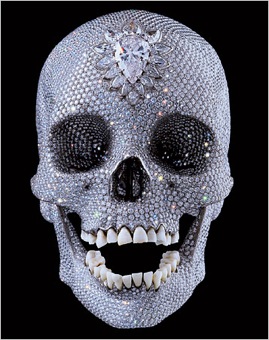
$4,000 Ashtrays and the value of Damien Hirst

I have been thinking more and more lately about how the value of a piece of art is determined and have come to the conclusion that the commodity in the equation is not the piece of art but rather the artist. Artist as celebrity or art as accessory. At this point it seems as though Hirst can create value out of anything. Ashtrays from his now-defunct restaurant just sold for $4,000 a piece. Hirst has become a commodity and an artifact all in one.
While I love his work I also question whether it is only death he speaks of. When i look at the work and hear the latest figures on what it cost for his little factory to turn out another piece I wonder if he is also making a sly commentary on what we value- and maybe that is the way we ward off death. If he keep making and the world keeps collecting and his name gets in the paper 10 times a week it creates a false sense of immortality- both for himself and the collector.
If it sells for his asking price of $100 million it will then be the single most expensive piece of contemporary art...what we buy says a lot about what we value. In this case it is not the meaning we value but the sensationalism. When people become consumers of art they finish the circle- by assessing value, they assess meaning which is what Hirst's art has become all about.

Sunday, September 2, 2007

How much of Damien Hirst's "For the love of God" is really a continuation of his treatment of death and how much of it is purely a money making name game to gain even more notoriety? I see this piece as much more of an investment in his (and others) financial future than a work of art. -denk

Sunday, August 26, 2007

Welcome!

Hi everyone! You've found the IUP Sculpture class blog. We'll use this as a place to discuss readings, make announcements, share information, etc.

Looking forward to a great semester!